
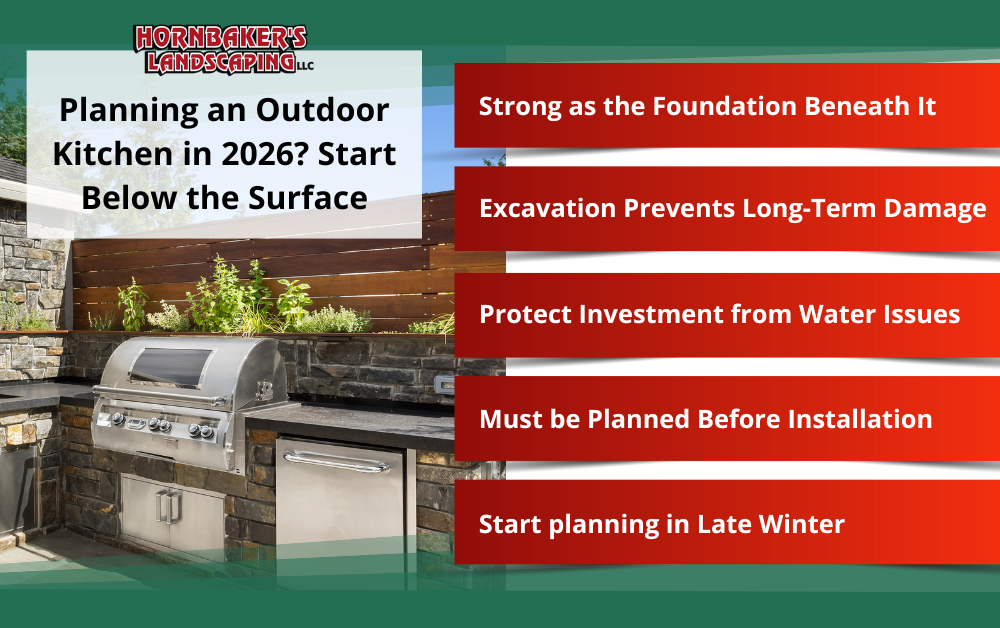
Outdoor living continues to grow in popularity, and the outdoor kitchen is leading the way. Homeowners across South Central Pennsylvania are investing in custom spaces that bring cooking, entertaining, and family time outside. From built-in grills and pizza ovens to full bar seating and refrigeration, the features are impressive.
But here is what many people overlook: the success of an outdoor kitchen does not start with appliances or countertops. It starts below the surface.
If you are planning an outdoor kitchen in 2026, the most important decisions you make will involve excavation, grading, drainage, and structural preparation. A beautiful design means very little if the foundation underneath it shifts, cracks, or collects water.
Every Outdoor Kitchen Is Only as Strong as Its Foundation
An outdoor kitchen is not a lightweight addition. Stone veneers, concrete countertops, brick pizza ovens, and built-in grills add significant weight. Without proper excavation and base preparation, that weight can cause settling over time.
Improper compaction often leads to:
- Cracking pavers
- Uneven surfaces
- Shifting retaining walls
- Water pooling near cooking areas
- Structural instability
Professional excavation ensures that unstable soil is removed, the base is properly compacted, and the area is prepared to support long-term weight. This is especially important in Pennsylvania, where freeze and thaw cycles can expand and contract the ground beneath your hardscape.
When excavation is handled correctly from the beginning, your outdoor kitchen becomes a long-term investment instead of a short-term cosmetic upgrade.
Site Evaluation Comes Before Design
Before finalizing layouts and materials, your property needs to be evaluated.
Every yard is different. Soil composition, slope, drainage patterns, and access for equipment all impact how your outdoor kitchen should be built.
A proper site evaluation includes:
- Assessing soil stability
- Reviewing elevation changes
- Identifying underground utilities
- Evaluating drainage flow
- Determining equipment access
Skipping this step often leads to costly rework. For example, installing a kitchen in a low-lying area without correcting grading can result in water pooling under cabinets and appliances. In winter, that moisture can freeze and create surface damage.
Starting with excavation and professional planning ensures the design fits the land instead of fighting against it.
Grading and Drainage Protect Your Outdoor Kitchen Investment
Water is one of the biggest threats to any outdoor structure.
Late winter snow melt and spring rain can test even well-built patios. Without proper grading, water will collect around your outdoor kitchen, potentially damaging finishes and weakening the base below.
Correct grading ensures:
- Water flows away from structures
- Surfaces remain stable
- Erosion is minimized
- Foundations remain dry
In many cases, drainage solutions such as French drains, channel drains, or subsurface systems are installed during excavation. Addressing drainage before installation prevents future headaches and protects your investment for years to come.
An outdoor kitchen should be a place to entertain, not a place to worry about standing water after every storm.
Utility Planning for a Modern Outdoor Kitchen
Today’s outdoor kitchen often includes more than a grill. Gas lines, electrical connections, water supply, and drainage are common features.
These utilities require trenching and careful coordination. Proper excavation ensures:
- Gas lines are safely installed
- Electrical conduit is protected underground
- Water lines are placed below frost depth
- Drainage lines are properly graded
Coordinating excavation with licensed trades early in the planning process avoids delays and code violations. When trenching is completed at the right stage, the installation process flows smoothly from groundwork to finished product.
Utility planning is one of the most important reasons to start below the surface.
Integrating Hardscaping and Excavation the Right Way
An outdoor kitchen rarely stands alone. It is usually part of a larger outdoor living space that may include:
- Paver patios
- Retaining walls
- Walkways
- Fire features
- Seating areas
These elements must work together structurally and visually. Excavation plays a critical role in tying everything together.
For properties with elevation changes, retaining walls may be necessary to create a level pad for the kitchen. Patios require compacted bases to prevent shifting. Walkways must be graded correctly to prevent trip hazards and water runoff issues.
When excavation and hardscaping are planned as one cohesive project, the result is a seamless outdoor environment that feels intentional and well-built.
Why Planning in Late Winter Sets You Up for a 2026 Install
If you are targeting a 2026 installation, late winter is the ideal time to begin planning.
Spring schedules fill quickly. Builders, landscapers, and excavation crews become booked as soon as temperatures rise. Starting early allows time to:
- Evaluate your site properly
- Finalize design plans
- Secure materials
- Schedule excavation before peak season
- Coordinate utilities without rushing
The typical sequence for a successful outdoor kitchen project looks like this:
- Site evaluation
- Excavation and grading
- Utility trenching
- Base preparation
- Hardscape installation
- Outdoor kitchen construction
Each step depends on the one before it. When excavation is rushed, everything that follows can suffer.
Planning now ensures your project moves forward smoothly when building season arrives.
Build It Right from the Ground Up
An outdoor kitchen is more than a trend. It is an investment in your home, your lifestyle, and your property value.
But no matter how impressive the appliances or how beautiful the stonework, the long-term success of your outdoor kitchen depends on what lies beneath it. Proper excavation, grading, and drainage create the stable foundation that protects your investment year after year.
For homeowners in Chambersburg, Greencastle, Gettysburg, Fayetteville, Shippensburg, Carlisle, Mechanicsburg, and Harrisburg, planning ahead makes all the difference.
If you are considering an outdoor kitchen in 2026, start below the surface. Contact Hornbaker’s Landscaping to discuss professional excavation, site preparation, and outdoor living design that sets your project up for lasting success.